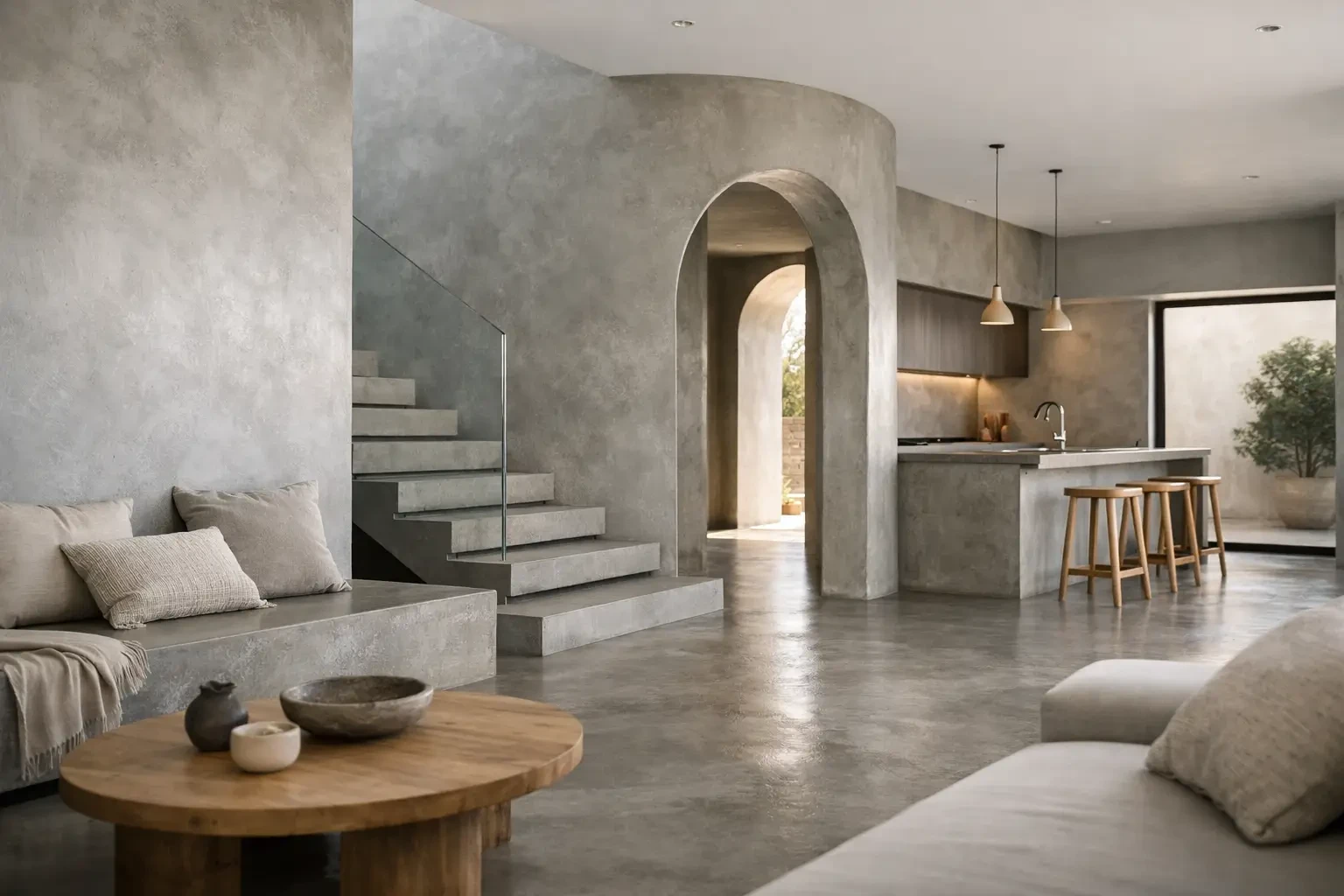
A material that continues from the floor onto the wall, frames a seamless bathroom, and gives a hospitality space a calm, monolithic identity requires more than the right colour choice. Microcement is an architectural surface with a strong aesthetic presence, but its ultimate value lies in the relationship between the substrate, detailing, use, and quality of application.
For high-end residences, boutique hotels, restaurants, and projects subject to demanding daily wear, it offers a distinctive balance: clarity of composition, tactile quality, and adaptability. It is not, however, a material chosen solely from a sample. It needs to be properly integrated into the overall design.
What microcement expresses in a space
Microcement is a multilayered system of thin coatings applied over a suitably prepared substrate and completed with protective layers. Its appearance does not seek the industrial uniformity of a standardised tile. Instead, subtle variations in texture, clouding, and surface movement are part of its character.
This character makes it ideal for architectural compositions in which the material must function as a unified background rather than as a repeating pattern. In a living room, it can highlight timber finishes, natural fabrics, and carefully selected rugs. In a bathroom, the continuity between floor and wall creates a sense of calm and visual spaciousness. In a hotel common area, it can support a restrained, timeless palette without appearing cold or flat.
The surface can range from more textured and earthy to highly refined and fine-grained, depending on the system, application tool, and desired feel. Colour is also not simply a matter of hue. It is influenced by lighting, proximity to other materials, and the natural or artificial shadows within the space. For this reason, evaluating real samples within the context of the design is essential.
Where it performs best
The versatility of microcement allows it to be applied to floors, walls, stairs, bathrooms, countertops, and selected exterior surfaces. Each application, however, has different technical requirements. A residential floor does not receive the same loads as a hotel lobby, while a shower wall requires different moisture management from a living-room wall.
In homes, it is often chosen when continuity between interior spaces is desired, or when creating a quiet shell that allows furniture and objects to take centre stage. In renovations, the system’s minimal thickness can be a significant advantage, provided the existing surfaces are stable and can be properly prepared.
In hospitality and dining environments, the choice is often connected to the ability to create a cohesive experience from the entrance through to the rooms and wellness areas. Projects such as NOŪS Santorini and Grand Hyatt Athens demonstrate how decisive material consistency can be in environments where aesthetics must coexist with intensive use and strict operational demands.
For exterior spaces, the design becomes even more specific. Exposure to ultraviolet radiation, temperature changes, water drainage, and the required slip resistance must be considered from the outset. There is no single solution for every terrace, courtyard, or pool perimeter. The correct system depends on the climate, slope, substrate, and actual intensity of use.
Technical precision begins beneath the surface
The most common misconception is that the success of the application is determined by the final coat. In practice, the result is defined much earlier: through moisture control, substrate stability, cracks, slopes, and construction joints.
Microcement follows the substrate. If the substrate has movement, weaknesses, or inadequate preparation, no aesthetically flawless final layer can guarantee long-term performance. For this reason, site inspection and technical mapping of the space are an integral part of the process, particularly in renovations and projects with multiple existing layers.
The details are equally critical. Junctions with frames, drains, grates, steps, built-in furniture, and expansion joints should not be treated as last-minute issues. These details determine both watertightness and the clarity of the final appearance.
In wet areas, waterproofing and slope management must precede the aesthetic coating. In commercial spaces, a clear assessment is required of traffic levels, possible contact with cleaning products, and the need for slip-resistant performance. Correct specification is not excessive—it is how the surface retains its value over time.
A surface with character, not artificial perfection
Those who choose microcement should appreciate its natural expressiveness. Subtle colour variations, marks from the handcrafted application, and changing readings under shifting light are not defects. They are the elements that distinguish a living surface from a perfectly repetitive industrial finish.
This does not mean that the result is uncontrolled. With the selection of appropriate samples, agreement on the desired texture, and proper organisation of the surfaces, the design remains entirely controlled. The difference is that uniformity is defined as design coherence, rather than the exact duplication of every square centimetre.
This decision also affects the relationship with other materials. The warm tones of microcement work particularly well with oak, walnut, brass, linen, and stone. Cooler tones can support more minimalist or coastal compositions, provided the lighting is carefully designed so that the space does not lose its warmth.
Maintenance and long-term performance
A properly completed surface does not require complex daily care, but it does require consistency. Cleaning with mild, suitable products and avoiding highly acidic or abrasive cleaners help protect the final layer. In high-traffic areas, periodic assessment of the protective coating is a sensible maintenance practice, not an indication of failure.
Durability does not mean remaining unchanged. Like any high-quality surface, microcement develops its own patina through use. In a private home, this evolution can enhance the sense of authenticity. In a hotel or commercial project, the specification and maintenance programme must ensure that the patina remains controlled and compatible with the brand image.
From sample to complete application
Material selection becomes meaningful when it is connected to real project data: drawings, surface conditions, use, schedule, and expectations for the final result. DKD approaches microcement as a customised solution rather than a generic finish, offering guidance from the selection of texture and colour through to technical preparation and application by skilled craftsmen.
For an architect or owner, the most useful principle is simple: before deciding on the colour, it is worth deciding how the space will be lived in. That is the foundation for a surface that will not only impress at project handover, but remain meaningful through every day of use that follows.